
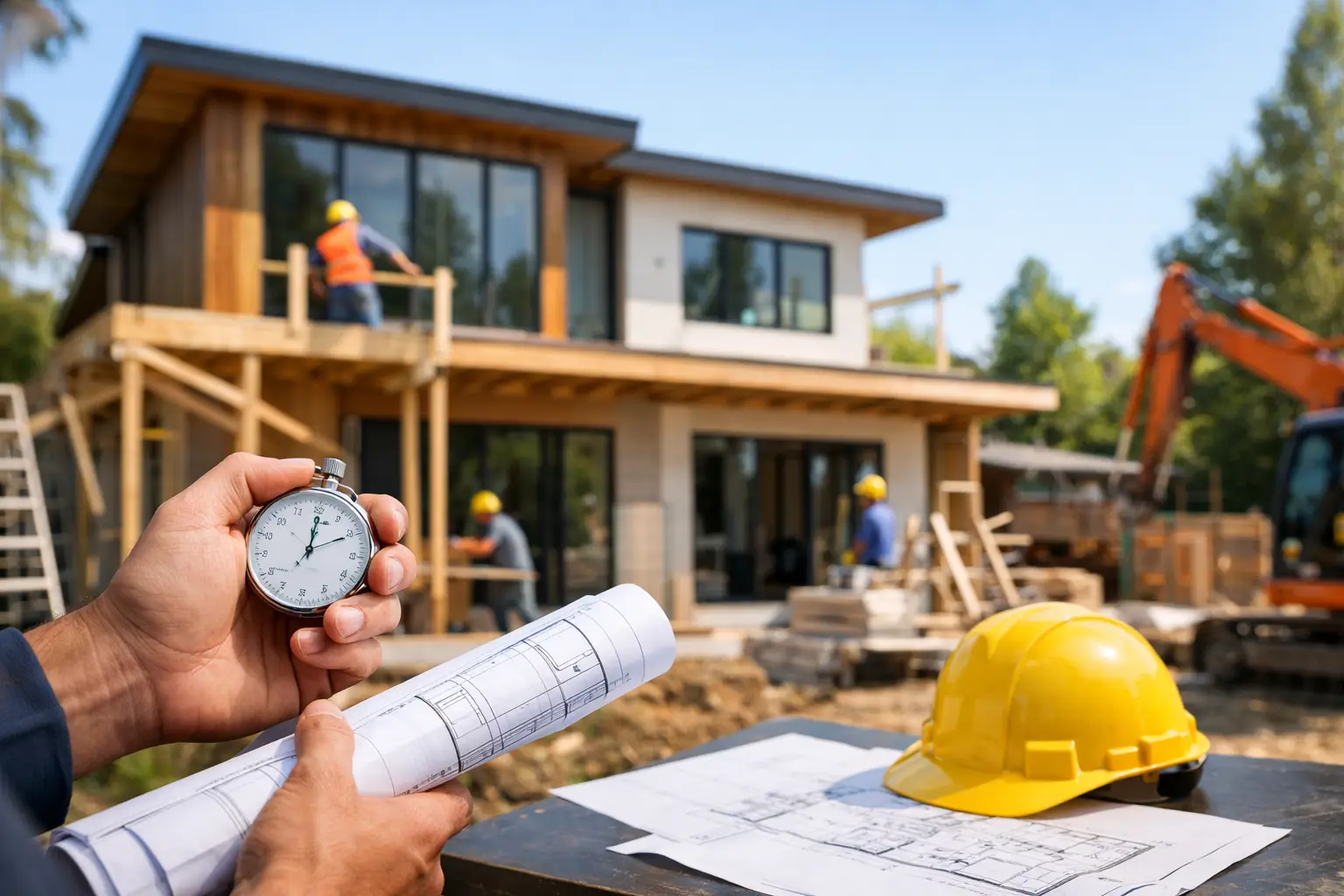
If you’re asking how long custom build takes, you’re usually not looking for a glossy estimate. You want a realistic timeframe you can plan around – school terms, finance approvals, lease end dates, demolition, and the point where a set of drawings finally becomes a home. The honest answer is that a custom build in Victoria commonly takes 12 to 24 months from first consultation to handover, with the exact timing driven by design complexity, council requirements, site conditions and how decisions are managed along the way.
That range is broad for a reason. A straightforward custom home on a compliant block can move far more efficiently than an architect-led build on a sloping site, or a knockdown rebuild in an area with tighter planning controls. The mistake many owners make is focusing only on the on-site construction period. In reality, the timeline starts well before the slab goes down.
How long custom build takes from start to finish
A custom build is usually made up of three major phases: pre-construction, approvals, and construction. Each phase matters, and delays in the early stages nearly always flow through to site works.
Pre-construction often takes 3 to 6 months. This covers the initial brief, concept design, budget alignment, site information, engineering input, selections and working drawings. If the design is clear and the client is decisive, this stage can move well. If the brief keeps changing, the timeline stretches quickly.
Approvals can take another 2 to 6 months, and sometimes longer. This depends on whether the project needs planning approval, how responsive council is, whether there are overlays on the land, and how complete the documentation is at lodgement. A building permit on its own is usually more predictable than a full planning pathway, but every site has its own constraints.
The construction phase itself commonly takes 7 to 12 months for a custom home, though larger or more complex homes can run beyond that. Weather, trade availability, material lead times and latent site issues all affect the build programme. For a dual occupancy or major structural renovation, the construction period can be longer again because sequencing is more complex and compliance demands are heavier.
What happens before construction even starts
This is where many timelines are won or lost. A disciplined pre-construction process saves time later because it reduces redesign, variation risk and permit complications.
The first step is clarifying the brief. That means more than deciding on bedrooms and finishes. It includes understanding your site, your budget, your priorities and the standard of build you expect. If you want a home with proper attention to structural details, waterproofing, flashing, insulation performance and long-term durability, those decisions need to be reflected early in design and documentation.
Next comes site investigation. Depending on the project, this can include feature and level surveys, soil tests, engineering advice and review of planning controls. On paper, a block may look straightforward. On site, it may have fall, access constraints, easements, poor soil classification or drainage issues. These are not minor technicalities. They directly affect cost, engineering and build time.
Then there is documentation. Custom building takes longer than volume building because the home is being tailored to the site and the client, not pulled from a standard catalogue. That extra time is not waste. It is where structural intent, compliance and buildability are properly resolved.
Why approvals can add months
If you want a reliable answer to how long custom build takes, you have to account for approvals properly. In Victoria, planning requirements vary significantly from site to site.
Some projects can move straight to building permit once the documentation is ready. Others need town planning approval first, particularly for knockdown rebuilds in sensitive areas, dual occupancy developments, or homes affected by overlays. Neighbour objections, requests for further information and council workload can all add time.
Even where the design is strong, approval timing is not entirely in the builder’s control. What is in the builder’s control is the quality of the documentation, consultant coordination and how early potential issues are identified. That is why a disciplined design-and-construct approach often saves time overall. It reduces the back-and-forth that happens when drawings look good in principle but are not resolved enough for permits or construction.
How long the build itself usually takes
Once permits are in place and the site is ready, a new custom home often takes 7 to 12 months to build. For some homes, especially larger residences with detailed joinery, high-end finishes or complex structural elements, 12 to 14 months is more realistic.
The early stages include site cut, excavation, footings, slab or subfloor structure, then framing. This part can move quickly if weather holds and access is good. But speed here means nothing if the underlying work is rushed. The unseen elements matter most – set-out accuracy, bracing, tie-downs, flashing details, membrane preparation, drainage falls. If these are wrong, problems are built in from the start.
After lock-up, the pace often looks slower from the outside. That is normal. Services rough-in, insulation, plaster, waterproofing, screeding, cabinetry, tiling, fit-off and painting all require sequencing and inspections. Trades are working over each other less than owners assume because quality construction depends on each stage being properly completed before the next begins.
External works also matter. Driveways, retaining, drainage, landscaping interfaces and service connections can affect handover timing, particularly in winter or on sites with poor access.
The biggest factors that change the timeline
Design complexity is the obvious one. A simple rectangular home with standard engineering will build faster than a split-level home with large spans, bespoke windows and complex roof lines. Every non-standard detail adds coordination.
Site conditions are just as important. Sloping land, reactive soil, rock, limited access or tight suburban sites can all slow excavation, deliveries and structural works. In established Melbourne suburbs, access alone can reshape a programme.
Selections and client decisions also have a direct impact. Custom homes involve more choices, and some products have long lead times. Stone, windows, feature cladding, imported fittings and custom joinery can hold up progress if they are not finalised early. The same applies to design changes after contract documentation is complete. Late changes do not just add cost. They interrupt sequencing and often trigger redraws, re-approvals or reordering.
Builder capacity matters too. A well-run project is not built by whoever happens to be free that week. It relies on qualified trades, proper supervision and realistic scheduling. A builder who promises an aggressive timeline without the systems to support it is not doing you a favour.
Custom home, renovation or knockdown rebuild – what takes longer?
A new custom home on a clear site is usually the most predictable.
A knockdown rebuild can add time upfront because demolition, service disconnections and site clearing need to be coordinated before construction begins. If the block is in an established suburb with planning sensitivity, approvals may also take longer. Once the site is clear, though, the build process itself is generally cleaner than a major renovation.
Major renovations and extensions are often the least predictable. The reason is simple: once walls, floors or roofs are opened up, hidden conditions appear. Existing structure may need rectification, services may not be where expected, and compliance upgrades can be triggered. That does not mean renovation is the wrong choice. It means the programme needs more contingency.
Dual occupancy projects typically take longer again because design, services, planning and construction sequencing are more involved. There is more to coordinate, more compliance to satisfy and often more external infrastructure to complete before final handover.
How to keep your custom build moving
The best way to keep a project on programme is to make good decisions early. Get the brief right, be realistic about budget, finalise selections before site starts where possible, and work with a builder who is thorough in pre-construction rather than eager to push paperwork out the door.
It also helps to treat the timeline as a live construction programme, not a sales promise. Good builders talk clearly about what is confirmed, what is dependent on authority approvals, and where site conditions may affect timing. That level of honesty protects the client because it sets proper expectations from the start.
For clients building in Melbourne and regional Victoria, the most reliable projects are usually the ones with strong documentation, fixed-price clarity, coordinated consultants and disciplined site management. That is not glamorous, but it is what gets homes built properly.
If you’re planning a custom home, the right question is not only how long custom build takes. It is whether the time is being used to produce a home that will perform well long after handover. A few extra weeks spent resolving details properly is often far cheaper than years spent dealing with defects that should never have made it into the build.