
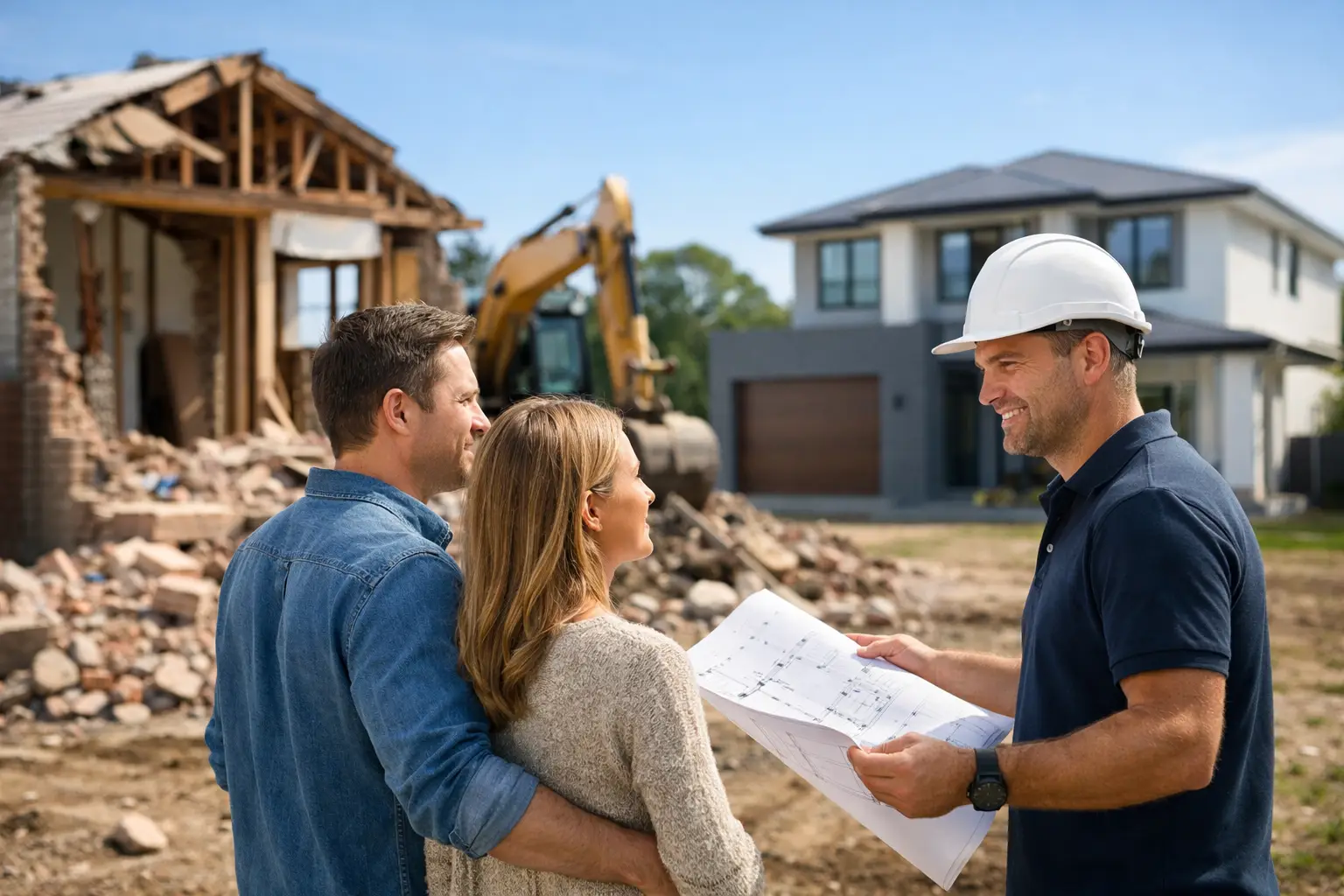
If you like your street, your school zone and your block, but not the house sitting on it, the right knockdown rebuild builder can give you a far better outcome than a compromise renovation. Done properly, it lets you keep the location and start again with a home that suits the way you actually live. Done poorly, it can become an expensive lesson in vague pricing, weak documentation and avoidable site delays.
That is why builder selection matters more in a knockdown rebuild than many owners first realise. You are not just hiring someone to construct a new home. You are engaging a team to assess the existing site, manage demolition, coordinate design, deal with planning and permits, price the works accurately and then deliver a structurally sound build with discipline.
What a knockdown rebuild builder should actually manage
A proper knockdown rebuild is not just demolition followed by a standard new build. The process starts with understanding the block itself – setbacks, easements, services, overlays, access, stormwater, neighbouring conditions and site constraints. If these are not picked up early, the design may need to change later, and that usually costs time and money.
A capable knockdown rebuild builder should be able to guide the project from early feasibility through to handover. That includes site review, concept input, consultant coordination, permit pathways, demolition planning, fixed-price documentation and construction management. Some builders only want to take over once drawings are complete. That can work, but it often creates a disconnect between design intent and build reality.
End-to-end delivery tends to produce a cleaner outcome because the builder has visibility over the details that affect both compliance and budget. That matters when you are dealing with existing site conditions, council requirements and the practical limits of the block.
Not all builders suit knockdown rebuild work
A builder may be excellent at greenfield homes on standard estates and still be the wrong fit for a knockdown rebuild in an established suburb. Inner and middle-ring Melbourne blocks often come with tighter access, existing fencing, overhead power, older drainage, protected trees, restrictive covenants or planning overlays. Regional Victoria can bring different constraints again, from soil conditions to service availability.
This is where experience counts. A builder used to working in lived-in suburbs understands neighbour management, staging, site protection and the detail required before works begin. They know that demolition is not a throwaway first step. It needs proper scoping, service disconnections, asbestos consideration where relevant, and a clear understanding of what must happen before the slab can even be prepared.
The difference is usually visible in the questions they ask. An experienced builder wants to know what is behind the fence line, not just what façade you like.
How to assess a knockdown rebuild builder
The first thing to look at is process. If a builder cannot explain, in plain terms, how the project moves from initial consultation to design development, permits, contract and construction, that is a warning sign. You want a team that can show you where the risks sit and how they manage them.
Pricing is the next test. A fixed-price contract only means something if the scope is properly documented. If key items are missing, loosely described or pushed into allowances without good reason, the price may look competitive but fail under pressure once construction starts. A serious builder will invest time in documentation before putting a contract in front of you.
Then there is build quality, which should be assessed below the surface, not just at the selection studio level. Ask how they manage waterproofing, flashing, bracing, slab preparation, frame inspection and site supervision. High-end tapware and stone can be changed later. Structural shortcuts and poor moisture control are far harder and more expensive to fix.
Communication also matters. You should know who is managing your project, how often updates are issued and what happens when a design or site issue needs a decision. Good communication does not mean overselling. It means being direct early, so there are fewer surprises later.
The risks hidden in cheap quotes
Knockdown rebuild clients are often comparing several proposals, and that is sensible. But the cheapest number is not always the cheapest build. Lower quotes often come from one of three places: incomplete scope, unrealistic allowances or underestimation of site complexity.
For example, a quote may not fully account for demolition conditions, authority requirements, retaining, upgraded footings, drainage changes or energy compliance upgrades. Those costs do not disappear because they were omitted early. They generally return as variations or programme delays.
There is also the question of trade quality. If a builder is chasing the lowest possible delivery cost, corners often get cut in the areas most owners never see during construction – membrane detailing, cavity flashings, tie-downs, sealing, protection of materials and supervision of subcontractors. These are the details that determine how the home performs over time.
A premium builder is not simply charging more for the sake of it. In a well-run project, you are paying for stronger documentation, tighter management, licensed and insured trades, documented inspections and accountability when it counts.
Why design and site planning need to happen together
One of the biggest mistakes in knockdown rebuild projects is treating design and construction as separate conversations for too long. A plan can look excellent on paper and still be inefficient, over budget or poorly suited to the block.
Good builders bring practical thinking into the design stage. That might mean improving orientation, simplifying roof forms, resolving drainage more cleanly, protecting usable yard space or avoiding expensive structural overcomplication where it adds little value. It can also mean the opposite – identifying where spending more is justified because it improves durability, natural light or long-term liveability.
This is especially important if you are trying to balance design ambition with a fixed budget. The right builder will tell you early what is realistic and where cost pressure will sit. That honesty saves far more than it costs.
Permits, compliance and the parts clients should not have to chase
Planning permits, building permits, engineering, energy reports, demolition approvals and service coordination can quickly become fragmented if there is no clear lead party. Homeowners should not be left trying to chase consultants and reconcile conflicting advice.
A disciplined builder coordinates these moving parts so the project progresses in the right order. That includes making sure documentation is consistent, consultant input is incorporated before contract stage where possible, and approval pathways are understood from the outset. This reduces rework and helps protect the construction programme.
In Victoria, local conditions can vary substantially from one council area to the next. That is another reason local delivery experience matters. Approval strategy is not something you want worked out by trial and error on your block.
What a better client experience looks like
The best knockdown rebuild builder is usually not the one making the biggest promises. It is the one setting clear expectations, documenting decisions, pricing properly and building with care in the parts most clients will never inspect themselves.
That means regular communication, realistic timeframes, transparent inclusions and a site team that treats quality control as part of the job, not an optional extra. It also means standing behind the work with proper warranties, formal inspections and a genuine handover process.
For homeowners and families, that level of control matters because a knockdown rebuild is rarely a casual project. It is a major financial commitment tied to how you plan to live for years ahead. You need confidence that the structure, waterproofing, compliance and finish have all been handled to the same standard.
Builders such as Builda Group have built their reputation on this exact point – doing the job properly, with disciplined project management and attention to the unseen details that affect long-term performance.
The right question to ask before you sign
Instead of asking who can build the biggest house for the lowest rate, ask who can deliver the most reliable outcome on your block. That shifts the conversation from marketing to method.
A strong builder should be able to explain how they assess risk, how they prepare documentation, how they protect build quality and how they keep clients informed when conditions change. If those answers are vague, the rest of the project often will be too.
A knockdown rebuild can be one of the smartest ways to stay in the area you value while getting a home that actually fits your needs. Just make sure the builder you choose is as focused on structure, process and accountability as they are on the finished photos.