
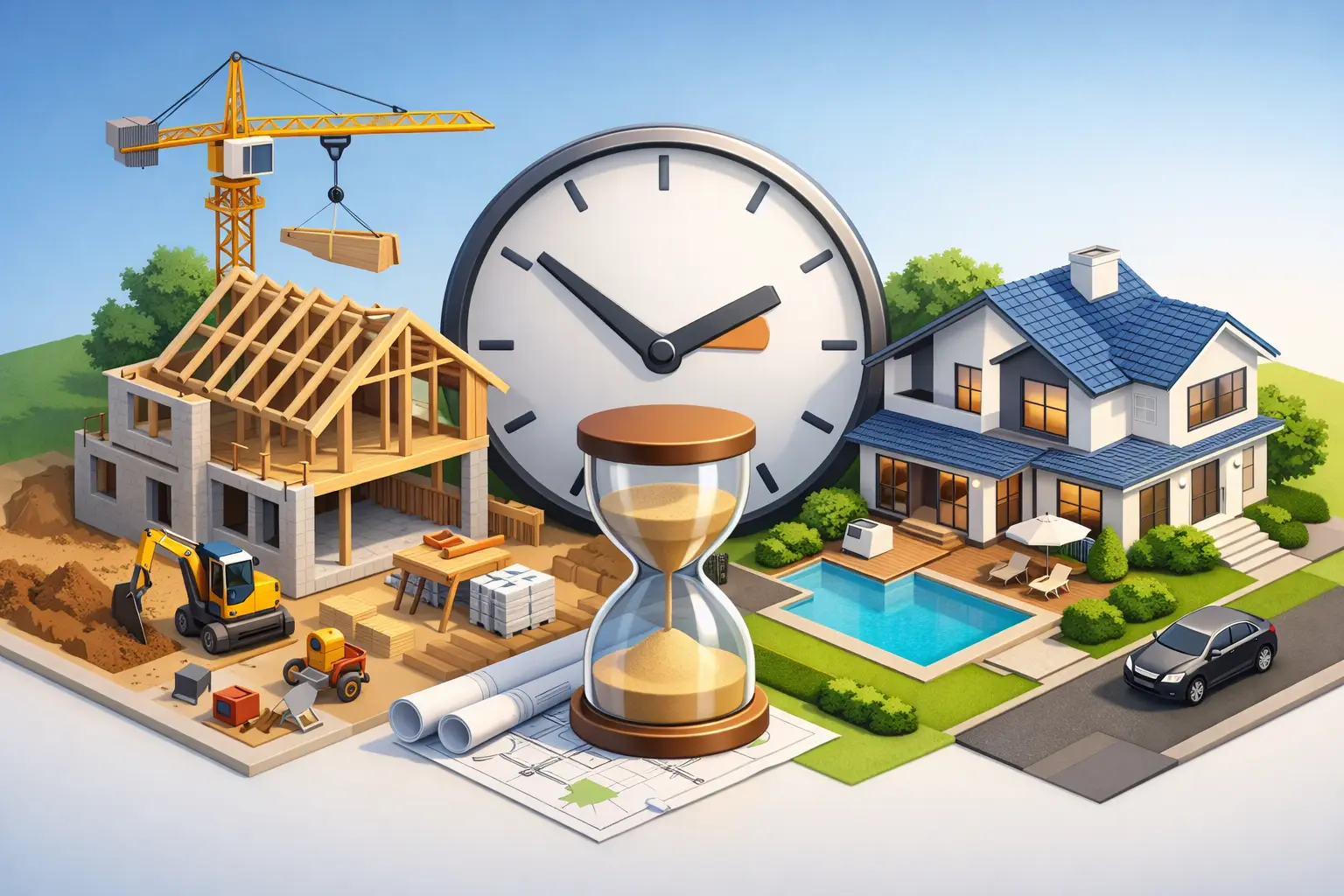
If you’re asking how long does it take to custom build a house, the honest answer is this: longer than most people expect, but faster when the project is properly planned, documented and managed from the start. In Victoria, a true custom home is rarely just a construction job. It is a sequence of design decisions, consultant input, permits, trade coordination, inspections and site conditions that all need to line up.
For most custom homes, a realistic overall timeframe is around 12 to 18 months from first consultation to handover. The build itself often takes 4 to 12 months, but that is only one part of the programme. Before a slab is poured, there is usually concept design, working drawings, engineering, energy assessments, selections, permit approvals and contract preparation.
That timeline can be shorter on a straightforward site with clear documentation and quick decisions. It can also stretch well beyond 18 months if the block is complex, the design changes repeatedly, or council and permit conditions slow things down.
How long does it take to custom build a house in Victoria?
A custom build generally moves through two broad phases: pre-construction and construction.
Pre-construction commonly takes 3 to 6 months, and sometimes longer. This includes the initial brief, site review, design development, consultant reports, engineering, soil testing, town planning where required, building permit documentation, specifications, and contract finalisation. If the home is architect-designed, on a sloping block, in a bushfire-prone area, or part of a knockdown rebuild, this phase can take more time.
Construction then typically takes 8 to 12 months for a standard custom single dwelling, depending on scale and complexity. Larger homes, high-end finishes, challenging access, suspended slabs, basements, or extensive external works can push that out further.
So when clients ask for a realistic number, 12 to 18 months is usually the right starting point. Not because builders like long programmes, but because quality residential construction involves more than putting frames up quickly.
What actually happens before the build starts
The pre-construction phase is where good projects are made or broken. Homeowners often focus on the site start date, but the real driver of programme certainty is what happens before anyone steps on site with tools.
First, the design needs to be resolved. That means more than floor plans. Levels, structural spans, window sizes, wet area layouts, façade details, materials, energy compliance and service requirements all need to be documented properly. Incomplete documentation leads to delays, variations and on-site guesswork.
Then there are reports and approvals. Depending on the project, this may include feature and level surveys, soil reports, engineering, BAL assessments, arborist advice, stormwater design or town planning. Some sites move through this stage cleanly. Others do not, particularly where overlays, easements, drainage constraints or neighbourhood character controls apply.
Selections also matter more than clients expect. Joinery, tiles, tapware, appliances, flooring, cladding and lighting all affect procurement and sequencing. If those decisions are left too late, the build can slow down waiting on lead times or revised shop drawings.
The construction timeline, stage by stage
Once permits are in place and site preparations are complete, construction starts to feel more visible. That does not mean every week looks dramatic. A well-run build is usually disciplined rather than rushed.
Site establishment, demolition if required, excavation and slab preparation generally take a few weeks, assuming weather and ground conditions cooperate. If unexpected rock, groundwater or latent site issues appear, that stage can change quickly.
The frame stage often moves faster than clients expect. Timber wall frames and roof framing can make the house look nearly complete in a short period. But this is also where structural accuracy matters. Bracing, tie-downs, lintels, connections and set-out need to be right. Speed means very little if those unseen elements are compromised.
Lock-up follows, with roofing, windows, external doors, wall wrap and cladding systems going in. At this point, the house becomes weather-resistant, which helps momentum. Internal rough-ins for plumbing, electrical and heating-cooling then begin, followed by insulation, plaster, waterproofing, cabinetry, tiling, carpentry, painting and fit-off.
The final stages usually take longer than clients expect because they involve many trades working in sequence, often in tighter spaces, with less room for error. Waterproofing needs inspection. Tilers need substrates ready. Joinery installation relies on dimensions being exact. Final fit-off depends on earlier work being complete and compliant.
Defects rectification, practical completion checks, final inspections and handover are also part of the programme. A disciplined builder will not treat these as an afterthought.
What causes delays in a custom home build?
Not every delay is avoidable, but many are predictable.
Design changes during construction are one of the biggest causes. Moving walls, changing windows, revising kitchens or altering structural details after work has started creates a domino effect. It is not just the change itself – it is the redocumentation, pricing, ordering, rescheduling and sometimes rework that follows.
Site complexity is another major factor. Sloping blocks, difficult access, poor soil, drainage issues and infill suburban sites can all slow progress. What looks straightforward from the street can be very different once excavation begins.
Approvals can also affect timing. If town planning is required, or if permit comments trigger document revisions, the pre-start period can extend significantly. This is especially relevant for knockdown rebuilds, dual occupancy projects and homes in overlay areas.
Weather still matters, particularly during earthworks, slab stages and external works. Melbourne conditions are not always kind to programme certainty.
Then there is procurement. Some materials and fixtures carry long lead times, particularly custom windows, specialist cladding, stone, imported fittings and certain appliances. If these are not ordered early, trades can be left waiting.
Finally, builder capacity and supervision make a real difference. A project with weak scheduling, poor trade coordination or limited site oversight often drifts. A properly managed build does not remove every issue, but it does keep the project moving when issues arise.
Why cheaper or faster is not always better
Many homeowners compare timelines the same way they compare quotes. On paper, one builder might promise a much quicker result. The question is what has been left out to create that promise.
Custom homes are not volume-built products on repeat plans and standard inclusions. They involve tailored details, site-specific engineering and more decision points. If the programme is compressed too aggressively, quality usually pays for it somewhere. That may show up in rushed waterproofing, poor flashing, inadequate coordination between trades or defects discovered after handover.
A serious builder allows time for the work that protects the house long term, not just the work clients can see on completion day. That includes inspections, compliance checks and attention to the structural and weatherproofing details that determine durability.
This is where an experienced, trade-led builder earns their place. Builda Group, for example, approaches timing with the same discipline as construction quality – realistic programmes, clear scopes and proper sequencing rather than optimistic promises that fall apart once the site gets busy.
How to keep your custom build on schedule
The best way to protect your timeline is to make good decisions early. Resolve the design before signing off for construction. Finalise selections as soon as practical. Be realistic about your budget so materials and scope are aligned from the outset.
It also helps to choose a builder who manages pre-construction properly, not just the site works. Fixed-price clarity, complete documentation, consultant coordination and stage-by-stage quality control all reduce the risk of delays later.
Ask direct questions. Is town planning required? Have long-lead items been identified? Who is supervising the build? How are inspections documented? What happens if weather or latent site conditions affect the programme? A quality builder should answer these without dancing around the issue.
The real goal is not simply a fast build. It is a well-run build that finishes with the right result.
If you are planning a custom home, treat the timeline as a project issue, not a marketing promise. A properly built house takes time, and that is not a flaw in the process. It is often the difference between a home that looks good at handover and one that still performs properly years later.