
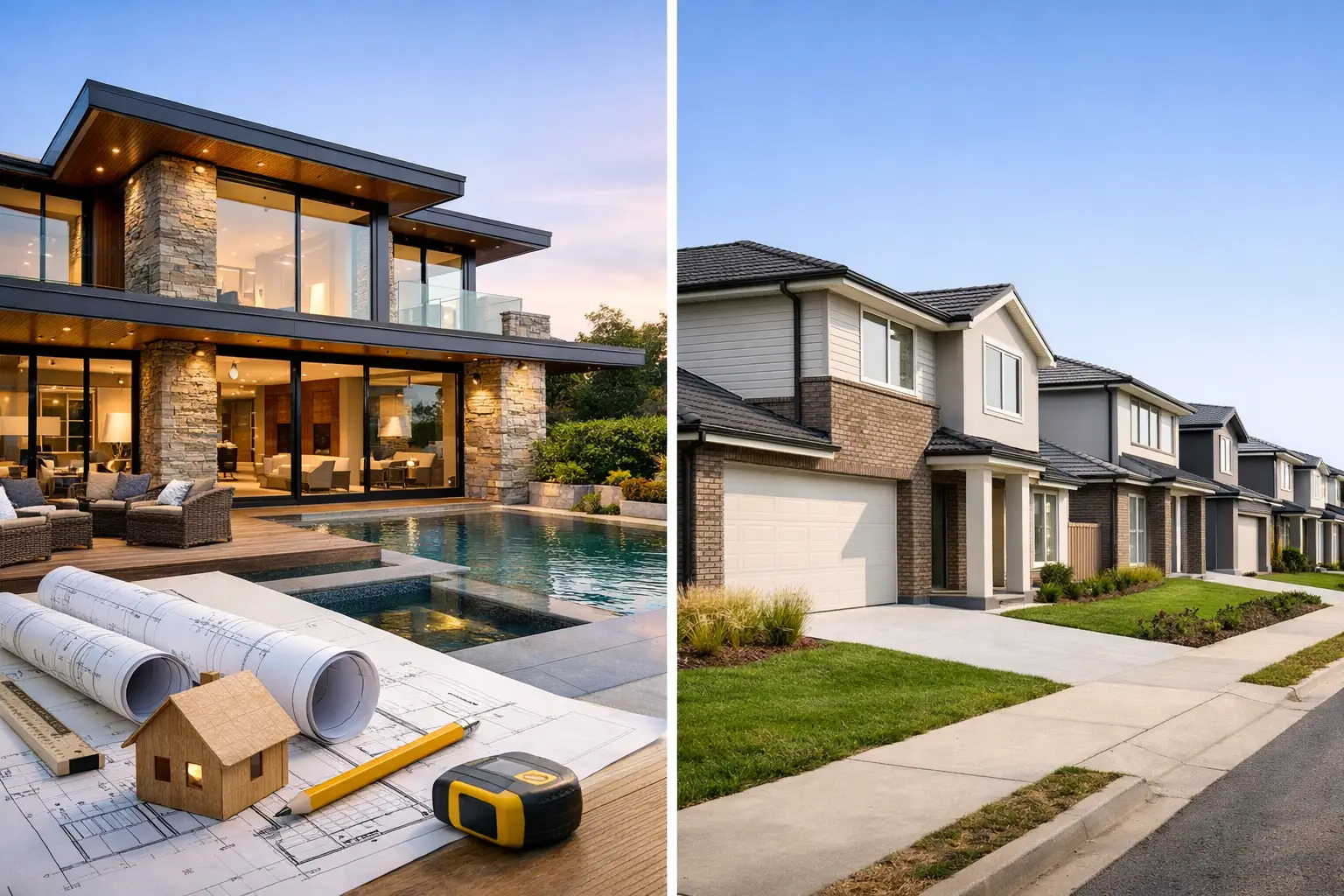
A floorplan can look impressive on a brochure and still be wrong for your block, your family and your long-term plans. That is usually where the real custom build vs volume builder decision starts – not with display home finishes, but with how the home is designed, priced and built once real site conditions and real client needs come into play.
For many Victorian homeowners, the choice is not simply about budget. It is about control, build quality, transparency and whether the builder is set up to solve problems properly when the project gets complex. If you are building a forever home, knocking down and rebuilding, or planning a dual occupancy outcome, the differences matter far more than the headline price.
Custom build vs volume builder: the core difference
A volume builder is built around repetition. Their model relies on standard plans, standard inclusions, repeatable processes and large construction pipelines. That can work well for straightforward greenfield builds on standard lots where the brief is close to what they already produce.
A custom builder works differently. The home is shaped around the site, the brief, the planning constraints and the way you actually want to live. That means more design flexibility, more technical coordination and usually a more hands-on pre-construction process. It also means the builder needs stronger project management and greater attention to detail, because custom work exposes every weak point in a sloppy system.
Neither model is automatically right or wrong. The question is whether the builder’s operating model suits the type of project you are undertaking.
Where volume builders can make sense
There is a reason volume builders are a major part of the market. If you have a relatively simple site, your priorities are speed of selection and a lower entry price, and you are comfortable choosing from a set menu of layouts and finishes, the volume model can be suitable.
Their systems are designed for efficiency. Selections are often packaged. Pricing can appear competitive at the start. The process can feel straightforward if your expectations align with what is already standardised.
That said, the value only holds when the project stays within those standard conditions. Once you begin changing layouts, upgrading specifications, dealing with planning issues or managing an irregular site, the apparent simplicity can start to shift.
Where a custom builder earns its place
A custom builder becomes more valuable when the project is not generic. Sloping land, narrow sites, knockdown rebuilds, architect-designed homes, large renovations and dual occupancy developments all require careful coordination well before construction begins.
This is where experience matters in practical terms. It is not just about being able to change a facade or move a wall. It is about understanding engineering, drainage, waterproofing, bracing, energy requirements, permit pathways and the sequencing of trades so that the finished home performs properly, not just presents well at handover.
For owner-occupiers who care about durability, layout functionality and long-term value, custom building often delivers a better fit because the project is being built around the actual brief rather than adapted from a template.
Price is only one part of the custom build vs volume builder question
A lot of people begin with the assumption that volume means cheaper and custom means expensive. Sometimes that is true at face value, but it is not the full picture.
Volume builders often promote attractive base prices. The catch is that base price and built price are not always the same thing. Site costs, upgrades, variations and items that were assumed rather than documented can shift the final number significantly. A lower starting price is only useful if the scope is genuinely clear.
Custom builders usually price the actual project in more detail from the outset. On a like-for-like basis, the contract figure may look higher because more of the real work has been allowed for early. For many clients, that creates better cost certainty rather than a nasty surprise halfway through the job.
The right comparison is not brochure price versus contract price. It is documented scope versus documented scope.
Design flexibility changes more than aesthetics
One of the biggest differences in custom build vs volume builder is how much the design can respond to the site and the family using it.
With a volume builder, the house is generally adapted to fit within a standard catalogue. You may be able to choose from several layouts, facades and upgrade packs, but the structure of the design is usually fixed by the builder’s system. That can limit orientation, room relationships, natural light, storage planning and how the home connects to outdoor areas.
With a custom build, those decisions start with how you live. Do you need separated living zones for teenagers? Better passive solar performance? A workable home office? A future-proof ground floor suite? A duplex layout that supports both market appeal and planning compliance? These are not minor extras. They shape the value and usability of the home for years.
Quality is often decided in the parts you cannot see
This is where the conversation needs to get more honest. Plenty of homes photograph well. Fewer are built with consistent discipline in the concealed elements that protect the structure over time.
The real test of a builder is not how polished the tiles look on practical completion day. It is whether the waterproofing was done correctly, the flashings were installed properly, the frame is straight, the bracing is adequate, penetrations are sealed, wet areas are detailed well and inspections are documented at the right stages.
In higher-volume models, speed and throughput can create pressure on supervision and trade consistency. That does not mean every volume-built home is poor quality. It does mean quality control becomes heavily dependent on systems, site oversight and whether issues are picked up before they are covered over.
A good custom builder tends to have tighter control over trades, stronger oversight and a greater willingness to spend time on the details that clients may never see but will absolutely pay for later if they are done badly.
Communication and accountability on site
Most problems in residential building do not start with one dramatic mistake. They start with assumptions, gaps in documentation, unclear inclusions or poor communication between office, site supervisor and trades.
That is why project structure matters. In a custom project, clients generally need more direct communication and clearer decision-making because the work is less repetitive. Done well, that produces better outcomes and fewer surprises.
For homeowners, the practical question is simple. Who is managing the job day to day? How are variations handled? What inspections are carried out? How are defects identified and closed out? If something on site does not match the drawings or specification, is there a disciplined process to address it?
A builder who can answer those questions clearly is usually operating at a different standard from one who relies on sales language and broad assurances.
Which option suits your project?
If you are building on a standard estate lot and your priority is selecting a proven plan with minimal design changes, a volume builder may suit. If your brief is straightforward and your expectations are aligned with standard inclusions and standard processes, there is nothing wrong with that path.
If, however, you are building on a more complex block, want a home tailored to your family, care about the unseen construction details, or need confidence around planning, coordination and fixed-price clarity, a custom builder is often the better fit.
That is especially true for knockdown rebuilds, architect-led homes, substantial renovations and dual occupancy projects across Melbourne and regional Victoria, where site constraints and compliance requirements rarely behave like a standard project.
Builda Group’s approach is built around that reality – trade-led, detail-focused and disciplined from pre-construction through to handover. For clients who want the job properly managed, that difference is not cosmetic. It is structural.
The better question to ask
Instead of asking which type of builder is cheaper, ask which model best matches your project and your tolerance for compromise. If the home is a major long-term investment, you want more than a sales package and a nice display fit-out. You want a process that deals honestly with site conditions, documents the scope properly and builds the house to last.
A home should suit the land, the brief and the people living in it. If your project needs flexibility, rigour and proper construction oversight, that answer usually becomes clear once you stop comparing brochures and start comparing how the work will actually be done.