
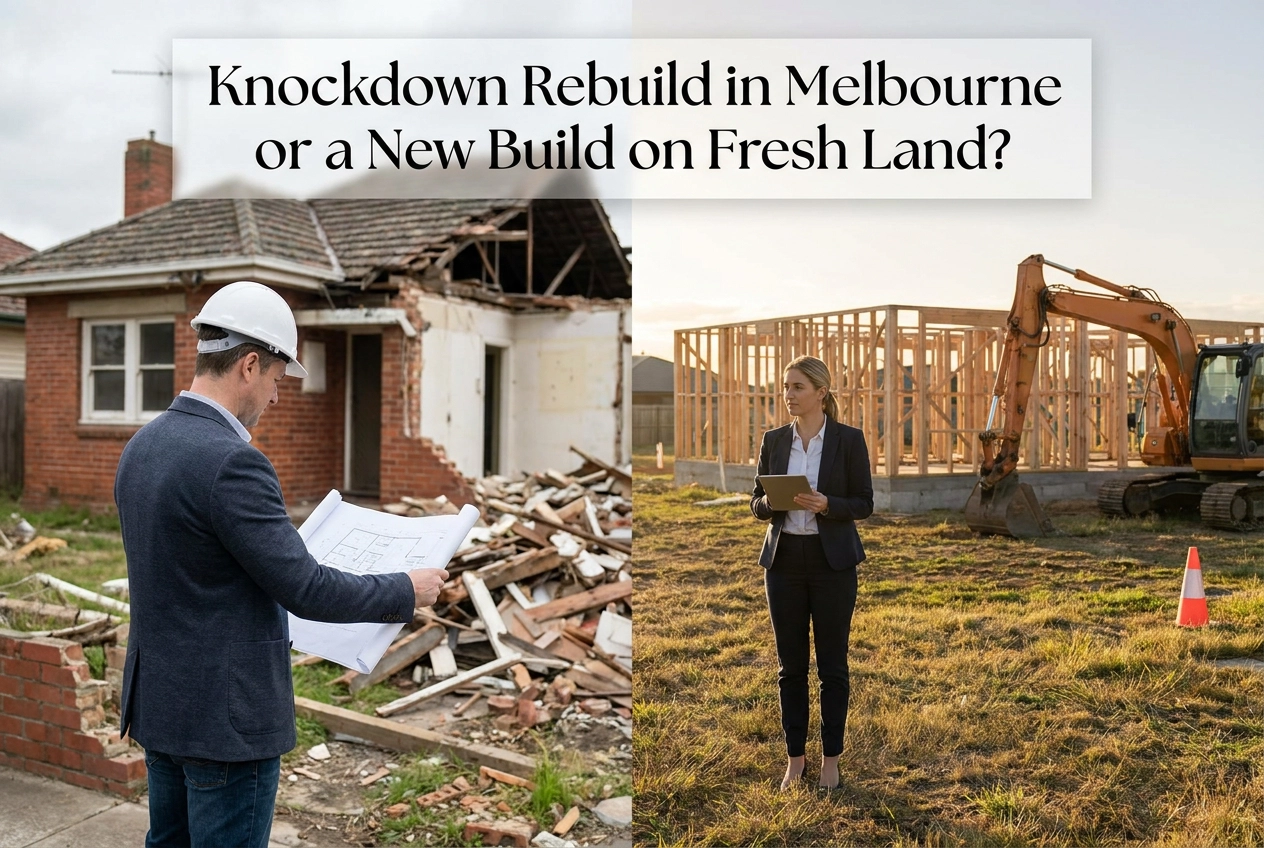
If you own an older house in Melbourne’s north, the choice between a knockdown rebuild Melbourne project on your current site and a new build on fresh land is rarely just about build cost. One path keeps the location and title you already own. The other trades them for a new set of site costs. Neither wins automatically. This comparison will show you how to weigh both routes without guessing.
You will work through what a knockdown rebuild in Melbourne actually involves, what building on fresh land requires, and why location and title are the two assets you cannot rebuild. We will cover the checks to run before you commit to keeping the site, why demolition, service connections and reusable approvals must be priced first, and what drives knockdown rebuild cost in Melbourne. You will then get a side-by-side comparison, a decision framework for your goals, and guidance on choosing a builder who advises you on either path. Builda Group delivers new residential builds, renovations and extensions across Melbourne and surrounds. By the end, you will know which path deserves your next step.
The Fork in the Road for an Older North-Suburb House
Both paths end with a new home you designed. The real difference is what you inherit with the land: an asset or a liability.
Older homes across Melbourne’s north usually sit on established streets with schools, transport, mature trees and neighbours already in place. A fresh block elsewhere buys a different version of those things, often several years behind.
So this guide runs one test. Keep the site only if the location and the title are the asset. If they are not, a knockdown rebuild is just new-home money spent on land you would not buy today.
Builder commentary on this question is rarely neutral. Whether rebuilding or renovating is more cost-effective depends on the specific site, the scope of work and what the homeowner actually needs from the outcome. Not every builder is suited to knockdown rebuild work, and not every site suits it either.
What a Knockdown Rebuild in Melbourne Actually Involves
Demolition is a separate project: its own contractor, permit and waste bill. On an older home, asbestos and other hazardous materials are assessed before anything comes down.
Every service must be disconnected first: power, water, gas, sewer and telecommunications. Booking each disconnection is usually your job unless your contract says otherwise.
Reconnection is separate again. New connection points, meter relocation and authority inspections sit outside the demolition quote, which is where budgets quietly drift.
You then need planning and building permits for the new home. How a knockdown rebuild works from start to finish explains why approvals tied to the old dwelling rarely carry over, and why reuse is messier than most owners expect.
Site access shapes everything. Narrow driveways, street trees, overhead powerlines and tight boundaries decide what equipment reaches the block and what the build costs.
What Building on a Fresh Block Actually Involves
On a fresh block you are buying land and a build, so the money splits across the purchase price, stamp duty, conveyancing and only then construction. Stamp duty applies to the land purchase and must be budgeted separately from the build quote, confirm the current assessment basis with your conveyancer.
Titles on new estates often carry developer covenants and design guidelines that can restrict materials, setbacks and building envelopes. Estate contracts often include conditions on design and timing, read these carefully before signing.
Confirm with the developer where connection points sit and what connection the estate requires, the answer varies by estate.
What you give up is the location you already own. If your current street works for your family, a fresh block has to beat it on something other than novelty. Planning controls and site conditions can decide it for you.
Location and Title: The Two Assets You Cannot Rebuild
The fresh block solves the site, but it cannot buy back your street. Location is fixed the moment you decide to stay. Walk the block at school pickup, at peak hour and on a Saturday morning before you commit. If the address is genuinely why you bought, staying is defensible. If it is not, no new kitchen will fix it.
Title is the second asset, the one owners skip. Pull the title and the plan of subdivision and look for covenants, easements and restrictions that limit what you can build and where. An easement carrying a sewer main across the block can rule out the footprint you had in mind. Find that before you commit, not after demolition.
When location and title both hold up, rebuilding is the smarter call.
The Checks to Run Before You Commit to Keeping the Site
Location and title can pass and the scheme can still stop you. Search your address on the state planning portal and confirm the zone plus every overlay that applies. Neighbourhood character, heritage, significant landscape and bushfire overlays each change what is achievable.
Heritage is the sharpest constraint: demolition and works can require a planning permit, so establish early whether the overlay covers the dwelling, the whole site, or only a front fence.
Read the covenants with a solicitor or conveyancer, not a neighbour. Single-dwelling covenants, material restrictions and private agreements are enforceable, and council cannot waive them.
Book a pre-application meeting with your council’s planning department. Ask plainly whether a demolition and rebuild of your type would be supported, and what conditions they would likely impose.
Test the site, permits and authority requirements before you commit to keeping anything.
Demolition, Service Connections and Reusable Approvals: Price These First
Planning settles whether the site is viable, not what it costs to clear.
Ask your demolition contractor to break the quote into its components, asbestos assessment and removal, hardstand and driveway, tree removal and disposal fees, so each cost can be checked. Demolition is only part of the clearing cost, and a lump sum with no breakdown cannot be checked.
Price each disconnection and reconnection separately, and write down who arranges it: power, water, gas, sewer, telecommunications. Ask the demolition contractor and your builder the same question, then compare answers.
Do not assume an existing building permit or endorsed plan carries across. Approvals attach to a specific design. Confirm with your building surveyor whether the existing permit has any carry-over value before assuming it does.
Allow for protection work too. Owners must protect adjoining property from damage, and the building surveyor decides what is required, from underpinning to shoring and overhead protection (Protecting adjoining properties). On tight blocks, condition reports and neighbour notices add cost and time.
Price all of this before signing a building contract. A build figure without demolition and connection costs behind it is not reliable.
What Drives Knockdown Rebuild Cost in Melbourne
That is why we do not publish rates, and no builder should quote one from a web page. Site access, soil and footing conditions, slope, demolition scope, service reconnections and design extent all move the number. That is why when a knockdown rebuild is the better option depends on your site, not a brochure.
The fairest comparison is per square metre, on the same brief. Compare a rebuild of the home you want against a renovation of the home you have, not a renovation with a new kitchen against a rebuild with an upgraded facade.
A demolition and servicing quote done first gives your builder a real starting point, so ask for demolition, service connections, permits and construction separated in writing, as covered above, those four items bundled together hide where the risk sits. Building permits are a distinct regulatory requirement, not a line buried in a build price.
The only useful answer to knockdown rebuild cost in Melbourne is a site-specific quote, after inspection, with demolition and connection costs known.
Rebuild on Your Site or Buy Fresh Land: Side by Side
With those four line items separated, the two paths compare cleanly.
Money out the door. A rebuild concentrates spending on demolition, connections and construction. A fresh block adds land purchase, stamp duty and conveyancing on top of the build.
Approvals. An established site usually means a planning permit conversation about neighbourhood character and overlays, such as the Neighbourhood Character Overlay. An estate block trades that for developer design guidelines and estate timeframes.
Design control. You already know and can measure your block. A fresh block is cleaner underfoot but comes with the developer’s rulebook.
Risk. A rebuild concentrates risk underground: what demolition uncovers. A fresh block concentrates it in the land purchase and what the estate will approve.
Time. A rebuild runs demolition, approvals and construction in sequence. A fresh block runs settlement, approvals and construction, often with tighter deadlines.
If your site holds up once demolition and servicing are priced, see whether a knockdown rebuild suits your block. If not, fresh land earns a look.
The Decision Framework: Which Path Wins for You?
Those trade-offs reduce to a few tests.
Choose the rebuild if the location is why you bought, the title is free of covenants and easements that block your design, demolition and servicing come back within reach, and council signals support for a new dwelling on the site. Choose a fresh block if the location no longer suits your family, the title carries restrictions you cannot work around, the block is too constrained for the home you want, or demolition and servicing bring the total near the cost of land elsewhere.
Keep land, stamp duty and conveyancing on the fresh-block side of the ledger, and demolition and connections on the rebuild side, as the side-by-side above sets out.
Get two real quotes: one demolition and servicing quote for your site, one land plus build estimate for a block you would genuinely live on. If the two land close together, location and title break the tie, because they are the only things you cannot change after you commit.
Choosing the Builder Who Advises You on Either Path
Before either path gets to tile selection, the builder advising you should be talking about demolition, servicing and approvals. If they cannot explain what gets dug up, disconnected and reconnected on a knockdown rebuild, they are pricing a different project.
Ask whether they hold a Domestic Builder Unlimited licence, the Victorian registration covering all components of domestic building work. Verify it on the public practitioner register rather than trusting a business card.
Then test them with three questions: how permits and authority connections are handled, who is on site day to day, and what happens when demolition uncovers something nobody expected. Vague answers are the tell.
Builda Group is a licensed Victorian residential builder based in Melbourne’s north, with more than 10 years of hands-on experience across Melbourne and surrounds in custom new homes, renovations and extensions, unit developments, NDIS accessibility modifications and insurance repair work.
Get the sequence right: demolition and servicing priced first, then a contract, then a start date. That order protects you on both paths.
What to Do Next
Once you have that builder on the phone, give them something concrete to work with.
Start with three cheap checks: pull the title and plan of subdivision, confirm your zone and overlays on the state planning portal, and establish what demolition requires on your site. Any one of them can close the rebuild path before you spend money on design.
Then get the two numbers that settle it, keeping land costs on one side and demolition costs on the other, as set out in the decision framework above. Location and title break any tie.
A builder who reads your site, not just your brief, will save you more in that first meeting than any later contract negotiation.
Conclusion
Those four tests, location, title, priced demolition, and two honest totals compared side by side, are what separate a well-reasoned decision from a guess. Then call Builda Group, a licensed Victorian residential builder based in Melbourne’s north, with a Domestic Builder Unlimited licence and more than 10 years of hands-on experience across Melbourne and surrounds. Ask them to read your site, not just your brief. That first conversation is where the right path becomes clear.