
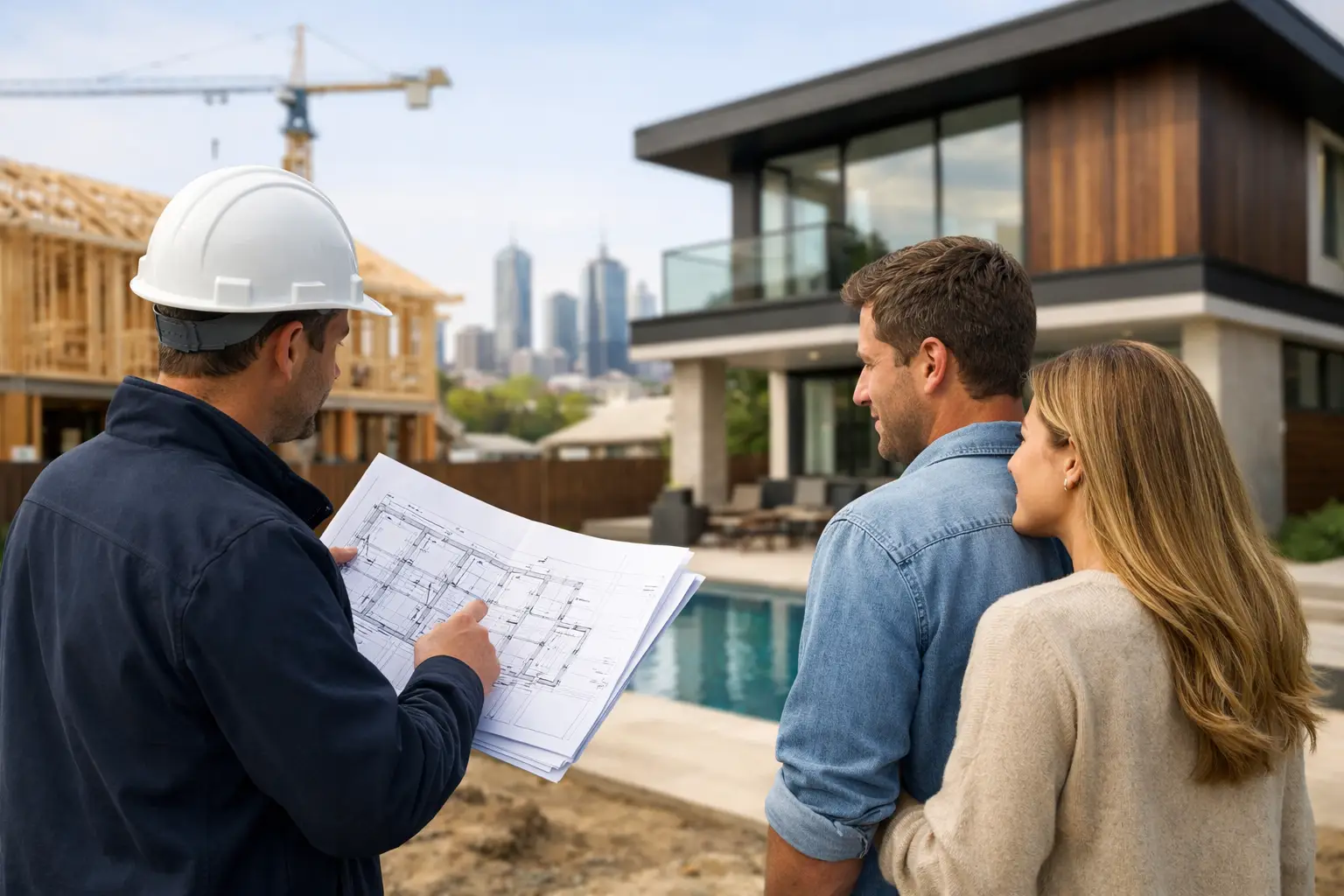
A custom home can look impressive at handover and still carry problems that only reveal themselves after the first heavy rain, hot summer or few years of movement. Waterproofing behind tiled walls, roof flashing, structural bracing and drainage are not glamorous decisions, but they are the work that protects your investment. That is why choosing the right custom builder in Melbourne should start with how a builder works, not simply how polished their display images look.
For a new custom home, knockdown rebuild, major renovation or dual occupancy project, the builder becomes responsible for turning a substantial financial commitment into a compliant, durable home. The right fit is not necessarily the lowest quote or the biggest name. It is the team with the capability, systems and accountability to manage your specific project properly.
Start with the builder’s relevant experience
Custom building is not one category of work. A builder who is well set up for straightforward project homes may not have the same experience with a constrained inner-suburban site, an architect-designed home, a live-in renovation or a dual occupancy development.
Ask for examples that resemble your project in scale and complexity. If your block has a steep fall, limited access or an existing home to demolish, ask how the builder has managed those conditions before. If you are extending a period property, find out how they approach tying new structure into old construction. For dual occupancy, look for experience coordinating design, planning, permits, services and construction as one controlled process.
The question is not whether a builder has completed attractive homes. It is whether they can identify the risks in your home before they become variations, delays or compromises on site.
Check the credentials behind the promise
A professional builder should be comfortable providing clear evidence of their registration, insurance and trade standards. In Victoria, check that the builder is appropriately registered with the Victorian Building Authority for the work being contracted. Confirm they hold current public liability insurance and that domestic building insurance will be arranged where required.
Credentials alone do not guarantee good work, but a reluctance to discuss them is a warning sign. The same applies to subcontractors. Ask whether the builder uses licensed, insured and qualified trades, and who checks their work before the next stage covers it up.
This matters most in concealed areas. Once plaster is installed or concrete is poured, correcting poor workmanship becomes expensive and disruptive. A builder with documented inspections at key stages is showing you that quality control is part of the programme, not an afterthought when a problem appears.
Ask what gets inspected and when
You do not need to be a construction expert to ask direct questions. Request an explanation of the inspection process for foundations, framing, waterproofing, roofing, external cladding and practical completion. Ask who performs the inspections, how issues are recorded, and how rectification is verified.
An honest builder will also explain the limits of site conditions. Existing homes can conceal damage, unsuitable soil can require additional engineering, and council or authority requirements can change the sequence of works. Good project management does not mean pretending these risks do not exist. It means identifying them early, documenting them clearly and dealing with them in a controlled way.
Compare scope before comparing price
A quote is only useful when you understand exactly what it includes. Two prices can be tens of thousands of dollars apart because one builder has allowed for a complete scope and the other has left significant items as allowances, exclusions or provisional sums.
Review the specification alongside the plans. It should make clear the materials, fixtures, site works, engineering requirements, permits, demolition allowances, connection works and finishes included in the contract. If an item is not defined, assume it needs further clarification before signing.
Provisional sums deserve particular attention. They can be appropriate where a cost cannot reasonably be known at contract stage, such as unforeseen ground conditions. They should not be used to make a proposal look artificially cheap. Ask what assumptions sit behind each allowance, what information could reduce uncertainty, and how any adjustment will be calculated.
A fixed-price contract provides stronger certainty when the design and documentation are sufficiently resolved. It does not remove the need for variations if you change the design, selections or scope after signing. The difference is that a disciplined builder makes the original scope clear, prices approved changes transparently and does not rely on ambiguity to recover margin later.
Choosing the right custom builder in Melbourne means testing communication
Most building disputes begin long before the final invoice. They start with unclear responsibilities, unanswered questions, undocumented decisions or expectations that were never agreed. Pay close attention to the way a builder communicates during the early stages. It is usually the best indication of how the job will be managed once construction begins.
Find out who your day-to-day contact will be. On a premium residential project, you should know who is overseeing the site, who coordinates trades and suppliers, and who is authorised to approve changes. Ask how often you will receive updates and what form they take. Regular site meetings, written progress updates and documented variation approvals are practical safeguards, not unnecessary administration.
Be wary of promises that sound too absolute. No credible builder can guarantee that every external supplier, weather event or approval pathway will behave perfectly. What they can guarantee is a clear process for communicating delays, protecting the site, revising the programme and keeping decisions moving.
Look beyond finishes to construction discipline
Joinery, stone and feature lighting are easy to notice. They are also easy to market. The harder test is whether the home is built to perform long after the styling trends have changed.
Ask the builder how they approach moisture management, roof and wall flashing, waterproofing, insulation, ventilation, drainage and structural connections. The answer should be specific to the build, not a vague assurance that they use quality materials. Materials only perform as intended when detailing and installation are correct.
For example, a bathroom is not protected simply because premium tiles have been selected. The substrate preparation, waterproofing system, penetrations, falls to waste and inspection before tiling are what reduce the risk of failure. The same principle applies across the home. Craftsmanship is visible in the finished details, but it begins in the work that is later hidden.
Understand the design, approvals and build pathway
Some clients arrive with completed architectural drawings. Others have a block, a budget and a clear idea of how they want to live. Neither approach is wrong, but the builder’s role should match where you are in the process.
A design-and-construct approach can provide useful cost and buildability input early, particularly for knockdown rebuilds, complex sites and dual occupancy projects. It can reduce the risk of designing beyond budget, provided the design brief, inclusions and allowances are handled transparently. Architect-led projects can offer a different level of design independence, but still benefit from early builder involvement to test construction methods, programme and cost.
Clarify who is responsible for planning, building permits, engineering, energy-rating requirements, surveys, demolition approvals and service connections. In Melbourne, approval pathways vary considerably by council, zoning, overlays and site conditions. A builder should not blur the distinction between a planning permit and a building permit, or imply that approval is automatic.
Speak to past clients with useful questions
References are worthwhile when you ask more than whether the clients liked the result. Ask whether the builder kept them informed, handled variations fairly, maintained the site well and addressed defects promptly. Ask what became difficult during the project and how the team responded.
Every build has pressure points. The aim is not to find a builder who claims never to face one. It is to find a builder whose clients describe calm, organised problem-solving when conditions change.
At Builda Group, this standard is built around detailed planning, fixed-price clarity where the scope allows, licensed trades and stage-by-stage checks that protect the integrity of the build. The focus is not just on a strong finish at handover, but on the structural and weatherproofing details that allow a home to keep performing.
Before you appoint a builder, take the proposed contract, scope and programme seriously enough to question every unclear line. A well-built home begins with a builder who is prepared to give straight answers before a ute arrives on site.