
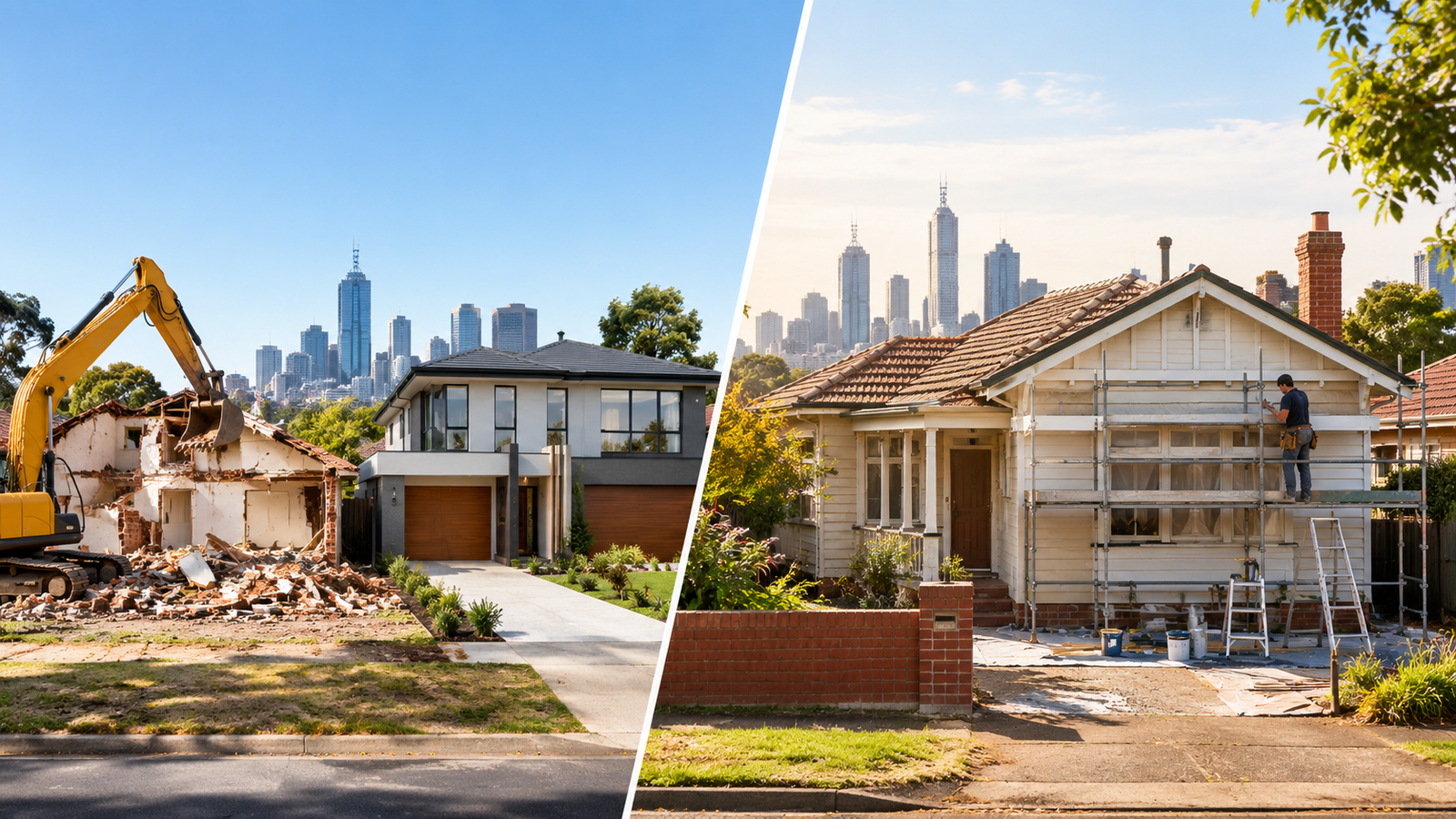
| Quick answer: Renovate if the structure is sound, drainage works and council rules favour keeping the home. Rebuild if recurring cracking or floor movement points to an unresolved structural issue, the layout fights every change, or the renovation quote climbs past roughly 50–60% of the cost of a new home. Three deal-breakers to check first: a heritage or character overlay that restricts demolition, ongoing structural movement, and asbestos throughout the building. |
Should you spend $350,000 patching a house you have outgrown or put that money towards one that actually fits your life? For most homeowners weighing a knockdown rebuild vs renovation in Melbourne, the answer comes down to what’s hiding behind your walls and under your floors.
Rebuild if recurring cracking or floor movement points to an unresolved structural issue, the layout fights every change, or repairs would swallow more than about half the cost of a new home.
Knockdown rebuild vs renovation in Melbourne – What Does It Cost?
These figures are broad indicative ranges only, not quotes. Melbourne construction pricing can vary significantly depending on site conditions, access, design, finishes, engineering, approvals and the final scope of work.
| Major renovation | Knockdown rebuild | |
| Typical total | $250,000–$450,000+ | $400,000–$900,000 |
| Hidden-cost risk | High (opens up as walls come off) | Lower (clear baseline) |
| Energy result | Improved, within limits | Built to current code |
| Disruption | Depends on scope, safety, services and construction staging | Temporary accommodation is generally required |
As broad indicative planning ranges only, a major whole-house renovation may fall around $250,000 to $450,000 or more, while a full knockdown rebuild may fall around $400,000 to $900,000. Demolition may add roughly $15,000 to $45,000 as an indicative allowance. Actual pricing should be based on the property, site conditions, design and documented scope rather than these figures alone.
When Does Rebuilding Become Better Value Than Renovating?
Builders use a simple test, that is price the renovation, then price the rebuild. Once the renovation costs roughly 50 to 60% of the rebuild, or you would be replacing more than half the house anyway, the maths tips towards rebuilding. Otherwise you’re paying near-new-home money for a home that’s still old.
What Should You Check Before Deciding?
Will your council allow demolition?
A heritage overlay or neighbourhood character control can rule out demolition before you’ve picked a single tile. Ask your council before you fall for a design.
Is your home’s structure still sound?
Recurring cracking or floor movement should be investigated before designing a renovation. The underlying cause may involve footing movement, drainage, soil conditions or other structural factors.
Does your home contain asbestos?
One in three homes built or renovated before 1990 will most likely contain asbestos. Where asbestos removal is required, any allowance such as $15,000 to $40,000 should be treated as a broad indicative range only. The actual cost depends on the material, quantity, location, accessibility, testing and licensed removal requirements.
Can your home meet Victoria’s 7-star energy standard?
Since 1 May 2024, new Victorian homes must meet the current 7-star energy-efficiency requirements. Significant renovations may also need to be assessed against current minimum energy-performance requirements depending on the scope and approval pathway. A knockdown rebuild is designed to current requirements from the outset, while the requirements for an existing home depend on the proposed renovation.
How predictable is your budget?
A renovation’s price can shift the moment a wall opens. A rebuild has a clearer baseline, though a 10–15% contingency is still wise.
Should you Renovate or Rebuild? A Quick Guide
Renovate if the frame is solid, the street’s character matters, or you would rather spread the spend. Renovating lets you stage the work over several years.
Rebuild if movement is serious, drainage keeps failing, asbestos runs throughout, or the layout is one you will never love.
The Bottom Line
The right choice depends on what your house allows, not on which option sounds better. Get the planning controls, structure, floor levels and asbestos checked first, and the decision usually becomes clear. For a straight answer on your block, Builda Group can walk you through both options.
What Builda Group Checks Before Recommending Renovation or Rebuild
Before recommending either option, Builda Group looks at the property as a whole rather than starting with a preferred construction approach.
We typically review:
- Planning and title requirements: overlays, restrictions and likely approval pathways.
- Existing structure: signs of cracking, movement, floor-level changes or areas requiring further investigation.
- Drainage and site conditions: site fall, stormwater, ground conditions and access.
- Existing services: water, power, sewer and gas locations and whether upgrades may be required.
- Asbestos risk: areas where testing or specialist advice may be needed.
- Design feasibility: what can realistically be achieved through renovation compared with a new-home design.
- Indicative cost comparison: comparing both pathways using the actual property, scope and project requirements.
Because Builda Group works across both renovations and new-home construction, the recommendation can be based on the property and the homeowner’s goals rather than pushing only one option.
Frequently Asked Questions
Is it cheaper to renovate or knock down and rebuild in Melbourne?
It depends on the condition of the existing home and how extensive the proposed renovation will be. A renovation can initially appear cheaper because you are retaining part of the existing building. However, costs can increase when structural problems, outdated plumbing or electrical systems, asbestos, drainage issues or other concealed conditions are discovered.
For a major renovation, it is worth obtaining an indicative price for both options before making a decision. Comparing the complete scope of each project provides a much more useful picture than comparing the initial construction prices alone.
When should I consider knocking down and rebuilding instead of renovating?
A knockdown rebuild may be worth considering when the existing house has significant structural problems, an unsuitable floor plan, extensive deterioration or requires so much alteration that very little of the original building would remain.
It can also make sense when your long-term requirements are substantially different from what the existing home can reasonably accommodate.
Is the 50–60% rule a reliable way to decide between renovating and rebuilding?
It can be used as an initial comparison, but it should not be treated as a fixed rule.
If a major renovation begins approaching a substantial proportion of the cost of demolishing and constructing a new home, it is sensible to compare both options carefully. The decision should also consider the condition of the existing structure, planning restrictions, design limitations, energy efficiency, expected maintenance and how long you intend to remain in the property.
How much does a knockdown rebuild cost in Melbourne?
The cost varies considerably depending on the size and design of the home, site conditions, soil classification, demolition requirements, engineering, access, materials, finishes and required services.
Rather than relying only on a price-per-square-metre figure, homeowners should consider the complete project cost, including demolition, design and consultants, permits, site works, construction, service connections, landscaping and temporary accommodation where applicable.
How much does it cost to renovate a house in Melbourne?
Renovation costs depend heavily on the amount of the existing house being retained and its condition.
Kitchens, bathrooms, structural alterations, extensions, roofing, plumbing, electrical upgrades, waterproofing and rectification of existing defects can significantly affect the final price. Older homes can also contain concealed conditions that are difficult to accurately price until work begins.
A detailed site assessment and clearly defined scope of works provide a more reliable starting point.